Seven of Swords: Discernment Is Not Deceit
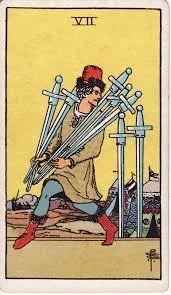
The Seven of Swords is one of the most misunderstood cards in the tarot.
It is often reduced to themes of dishonesty, trickery, or betrayal — as though any action taken quietly or strategically must be morally suspect.
But this interpretation tells us more about cultural discomfort with agency than it does about the card itself.
In its integrated expression, the Seven of Swords is not about lying.
It is about discernment.
It appears when the nervous system has learned something essential:
not every truth needs to be spoken,
not every conflict needs to be confronted,
and not every environment deserves full access.
This card emerges after clarity has dawned — often following periods of confusion, threat, or inner division. By the time the Seven of Swords appears, something has already been seen.
The question is no longer “What is happening?”
The question is “How do I move without causing further harm — to myself or others?”
From a nervous-system perspective, this card represents a shift away from reactivity.
Instead of:
explaining
defending
persuading
or exposing oneself to distortion
the individual chooses selective engagement.
This is not avoidance.
It is not manipulation.
It is energy preservation.
The Seven of Swords teaches that wisdom sometimes looks like:
taking what is yours without announcement
exiting quietly rather than escalating
withholding information from systems that misuse it
choosing effectiveness over moral theatre
In a culture that equates transparency with virtue, this can feel uncomfortable. But transparency without safety is not integrity — it is self-betrayal.
Discernment requires recognising when engagement will not lead to repair, understanding, or justice — only further depletion.
The Seven of Swords does not advocate deception.
It advocates clean departure.
This is the moment where personal agency is fully reclaimed:
no longer seeking permission,
no longer waiting to be understood,
no longer trying to educate those who have no interest in listening.
Action is taken — quietly, precisely, and without excess.
Importantly, this card also marks the end of outsourcing.
The individual no longer hands their nervous system to systems or people who cannot hold it responsibly.
What is retrieved here is not just material or outcome —
it is self-trust.
The Seven of Swords teaches this truth with restraint:
You do not owe access to those who misuse it.
You do not need to perform your integrity.
You are allowed to take what is yours and walk away.
That is not deceit.
That is sovereignty.