The Sovereign Eye — Opening Invocation
Welcome to the place where sight becomes truth.
Where clarity is not sharpness,
but compassion refined by lived experience.
Where the nervous system leads,
the soul remembers,
and the mind learns to follow.
This Journal is an archive of awakenings—
moments of vision, sovereignty, and quiet revolution.
Each entry is offered as a transmission:
a way of seeing that unravels old patterns
and restores you to your own inner knowing.
May what you read here meet you exactly where you are,
and open what is ready to open.
May it be a companion,
a mirror,
and a gentle disruptor.
This is The Sovereign Eye—
a space for truth without performance,
power without force,
and presence without apology.
Enter with an open heart.
Leave with clearer sight.
How I Practice
Principled Care | Glaucoma
Glaucoma care offers fertile ground for embodying our values — not in theory, but in how we choose, intervene, and refrain.
Glaucoma is rarely an emergency.
Yet it is often treated as one.
I see many patients arrive on multiple drops — added quickly, layered without clarity, driven by fear rather than understanding.
Action becomes a proxy for care.
But glaucoma does not respond well to panic.
One principle quietly guides my approach:
Minimum effective dose.
Not just pharmacologically — but systemically.
The minimum intervention that achieves the intended outcome, while preserving tissue, trust, and nervous system safety.
What this looks like in practice:
Discernment before accumulation
If we don’t know which drop is working, we don’t know what we’re treating.
Stepwise care is precision, not delay
Glaucoma is longitudinal. Rushing escalation creates noise, side effects, and loss of signal — not safety.
Side effects are data
Periorbital fat atrophy, pigmentation, ocular surface toxicity — these affect adherence, identity, and long-term engagement.
They are not cosmetic footnotes.
Education is a therapeutic intervention
Explaining why, how, and what next is not optional.
A regulated, informed patient gives better data over time.
Earlier minimally invasive options deserve consideration
SLT and MIGS, used appropriately, can reduce medication burden and long-term harm — especially in patients who will live with glaucoma for decades.
The same principles apply in surgery.
There is no one-size-fits-all — only careful, respectful discernment, followed by precise execution.
When fear leads, care escalates.
When discernment leads, care becomes precise.
Good glaucoma care is not loud.
It is measured, relational, and grounded in respect.
The Hermit: Integration Is Not Avoidance
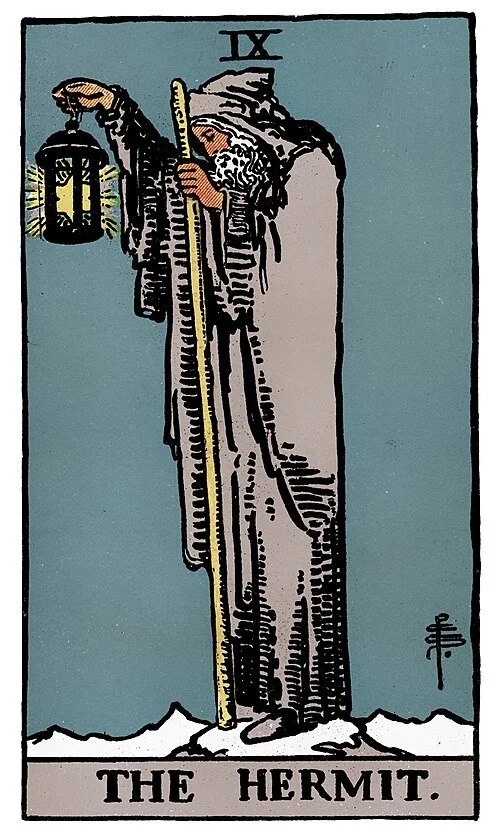
The Hermit is often misread as withdrawal, isolation, or disengagement.
But this interpretation comes from a culture that equates growth with constant movement and visibility.
In nervous-system terms, the Hermit represents intentional regulation — a phase where outward action slows so internal capacity can stabilise.
Nothing dramatic appears to be happening.
And yet, this is where the ground is prepared for sustainable expansion.
This phase is not held by insight alone.
It is held by daily self-compassionate practice:
small acts of orientation that tell the body it is safe to settle.
Not hypervigilance.
Not monitoring.
Not fixing.
Tending.
Without self-compassion, stillness becomes shame.
With it, stillness becomes integration.
The Hermit doesn’t step back to escape life.
He steps back to return with coherence.
The lantern he carries is no longer borrowed.
It is internal.
And from this place, action becomes quieter, cleaner, and truer.
Death: Letting Go Without Collapse
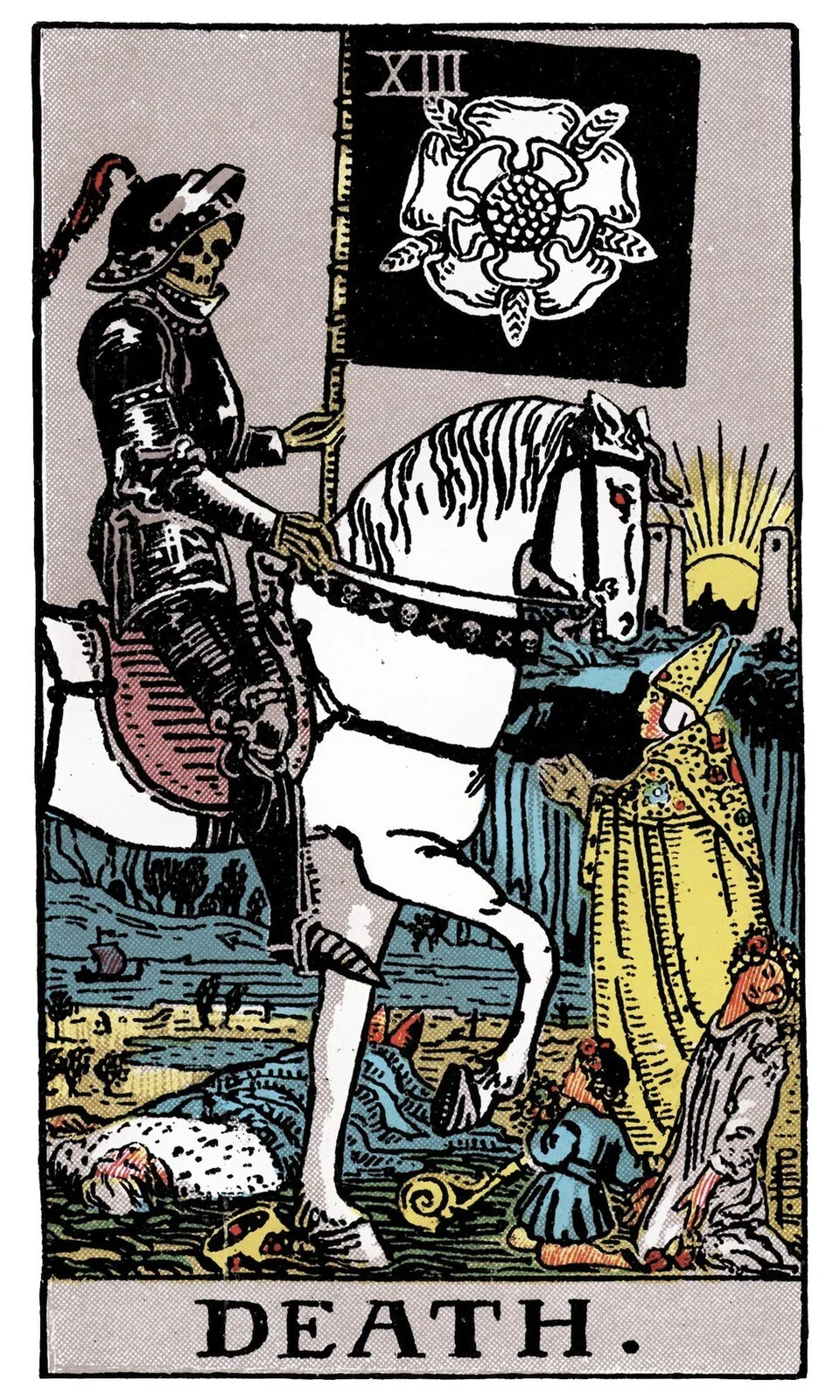
The Death card is one of the most feared images in the tarot.
It is often associated with loss, endings, and things taken too soon.
But this fear comes from misunderstanding what the card is actually pointing to.
Death, in tarot, is not about destruction.
It is about completion.
What ends was already finished.
What follows does not need to be forced.
If you look closely at the card, there is a detail that is often overlooked:
a young child offering flowers to the rider of Death — not in terror, but in curiosity.
There is no violence in that gesture.
There is innocence. Openness. Willingness to meet change.
What hurts us is rarely change itself.
It is our attachment to what has already completed.
From a nervous system perspective, this distinction matters deeply.
When endings are resisted, the body braces.
When endings are forced, the system collapses.
But when endings are allowed, the nervous system can stay regulated even in transition.
Death does not ask us to stop acting.
It asks us to act without gripping the outcome.
This is the paradox:
Aligned action is still required —
even when certainty is unavailable.
Letting go does not mean passivity.
It means releasing what no longer serves while continuing to move in integrity.
This kind of release requires attunement.
It requires the capacity to feel fear without being governed by it.
It requires trust — not blind faith, but embodied trust in timing.
When the nervous system is regulated, we can do this.
We can end things without collapsing.
We can step forward without guarantees.
We can allow what is finished to fall away without making it mean something is wrong.
Death teaches this quietly:
Release what is complete.
Act in alignment.
Trust the timing.
Nothing is being taken from you here.
Something is simply making space.
Seven of Swords: Discernment Is Not Deceit
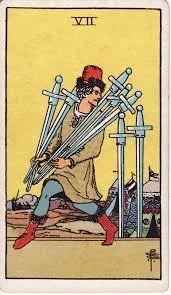
The Seven of Swords is one of the most misunderstood cards in the tarot.
It is often reduced to themes of dishonesty, trickery, or betrayal — as though any action taken quietly or strategically must be morally suspect.
But this interpretation tells us more about cultural discomfort with agency than it does about the card itself.
In its integrated expression, the Seven of Swords is not about lying.
It is about discernment.
It appears when the nervous system has learned something essential:
not every truth needs to be spoken,
not every conflict needs to be confronted,
and not every environment deserves full access.
This card emerges after clarity has dawned — often following periods of confusion, threat, or inner division. By the time the Seven of Swords appears, something has already been seen.
The question is no longer “What is happening?”
The question is “How do I move without causing further harm — to myself or others?”
From a nervous-system perspective, this card represents a shift away from reactivity.
Instead of:
explaining
defending
persuading
or exposing oneself to distortion
the individual chooses selective engagement.
This is not avoidance.
It is not manipulation.
It is energy preservation.
The Seven of Swords teaches that wisdom sometimes looks like:
taking what is yours without announcement
exiting quietly rather than escalating
withholding information from systems that misuse it
choosing effectiveness over moral theatre
In a culture that equates transparency with virtue, this can feel uncomfortable. But transparency without safety is not integrity — it is self-betrayal.
Discernment requires recognising when engagement will not lead to repair, understanding, or justice — only further depletion.
The Seven of Swords does not advocate deception.
It advocates clean departure.
This is the moment where personal agency is fully reclaimed:
no longer seeking permission,
no longer waiting to be understood,
no longer trying to educate those who have no interest in listening.
Action is taken — quietly, precisely, and without excess.
Importantly, this card also marks the end of outsourcing.
The individual no longer hands their nervous system to systems or people who cannot hold it responsibly.
What is retrieved here is not just material or outcome —
it is self-trust.
The Seven of Swords teaches this truth with restraint:
You do not owe access to those who misuse it.
You do not need to perform your integrity.
You are allowed to take what is yours and walk away.
That is not deceit.
That is sovereignty.
The Two of Swords Isn’t About Indecision
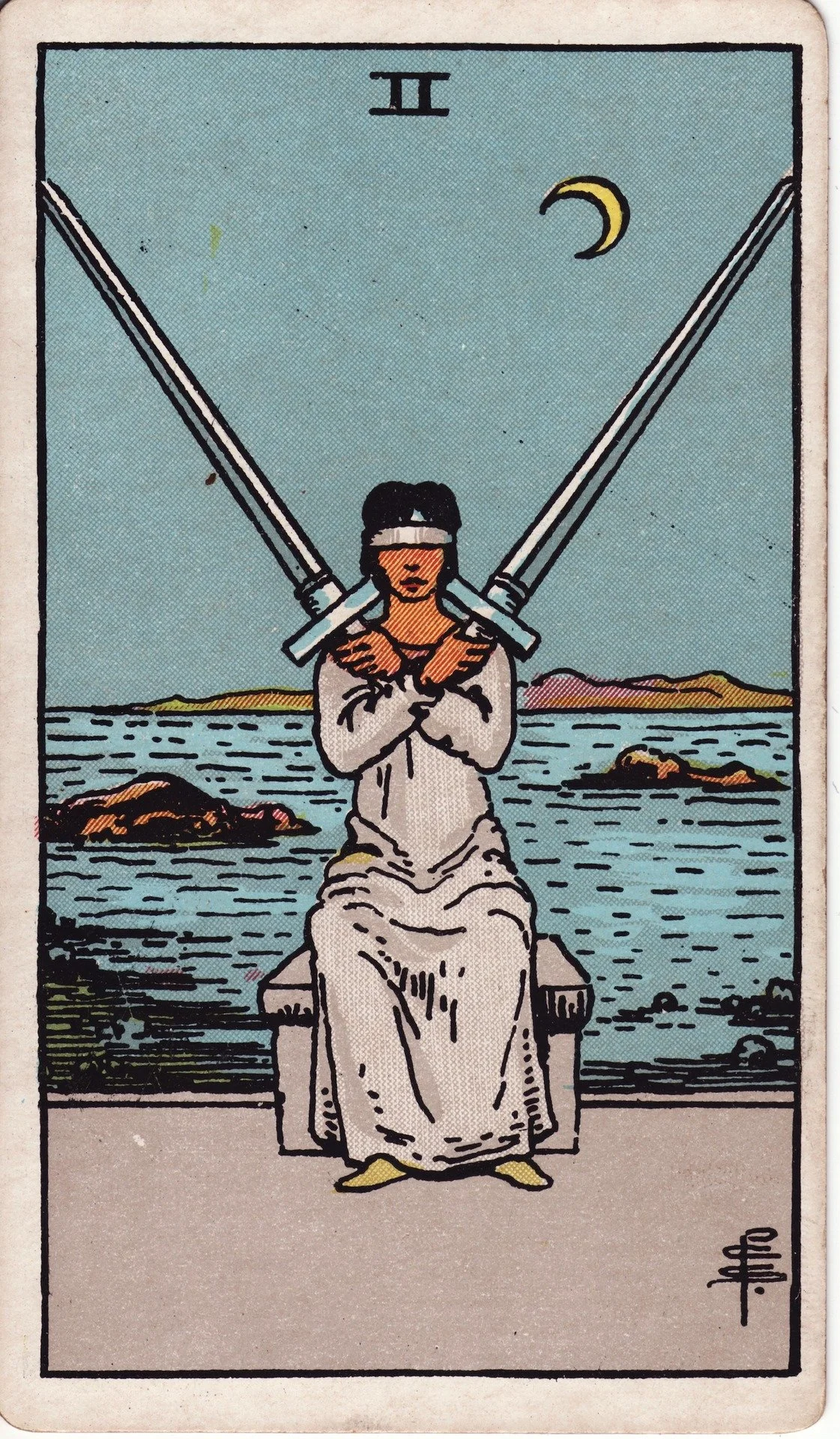
It’s About Protection.
We often read the Two of Swords as being “stuck between two choices.”
But what if that’s not the problem at all?
What if the nervous system is doing something very intelligent?
When the only options we can see both feel unsafe, undesirable, or self-betraying, we don’t choose.
We pause.
We narrow perception.
We put on the blindfold.
This isn’t weakness.
It’s protection.
Many of us live here for years:
Staying silent or blowing things up
Enduring or burning bridges
Obeying or rebelling
Two swords. Neither feels right.
So we tell ourselves these are the only possibilities.
But look closely at the card.
Behind the figure is an island.
The water looks impassable — but it’s low tide.
The third path isn’t dramatic.
It doesn’t require force.
It doesn’t require choosing either sword.
It requires removing the blindfold.
When we allow ourselves to see again, we often discover:
we were never as trapped as we believed
the binary was a stress response, not reality
there was space to step sideways, not just left or right
The Two of Swords teaches this quietly:
When the nervous system is overwhelmed, it collapses reality into false binaries.
Clarity doesn’t come from choosing harder — it comes from seeing wider.
Sometimes the most courageous act isn’t deciding.
It’s allowing yourself to look.
And often, once you do, the path that felt impossible has been patiently there all along — waiting for the tide to go out.
Lamp — No. Bulb — Yes.

There’s a scene in Friends that has stayed with me for years.
Ross is explaining hotel etiquette:
Mini shampoo? Yes.
Lamp? No.
Bulb? …Yes.
It’s funny because it’s ridiculous.
And it’s ridiculous because we recognise the logic.
Somewhere along the way, the question stops being
“Is this mine?”
and becomes
“Can I justify taking it?”
We see it with objects all the time.
Airline blankets. Hotel amenities. Apples from reception.
The reasoning usually sounds harmless:
We paid for the ticket.
They won’t miss it.
It’s already here.
Everyone does it.
But what interests me isn’t the object — it’s the logic.
Because once justification replaces respect, the same reasoning quietly migrates into relationships.
If I’m here, I can take your time.
If we’re family, I can cross your boundary.
If I meant well, intent should excuse impact.
If I helped once, I’m entitled indefinitely.
Access becomes ownership.
Proximity replaces permission.
And justification becomes the story we tell ourselves so we don’t have to pause and ask the simpler, more uncomfortable question:
Does this actually belong to me?
When something truly is yours, you don’t need a defence.
No mental gymnastics.
No moral footnotes.
No “technically speaking…”
You just know.
And when something isn’t yours, that knowing matters too.
Perhaps maturity isn’t about deciding what can be taken,
but about recognising when the urge to justify is already the signal to stop.
Lamp — no.
Bulb — yes.
And sometimes, the most respectful choice
is taking neither.

Masks, Fear and the Cost of Non-engagement
Lately, I’ve noticed how many people still wear masks — in hospitals, in cars, in daily life.
Sometimes it’s practical.
Sometimes it’s habit.
And sometimes, I sense, it’s something quieter.
Not fear as panic.
But fear as non-engagement with life.
Fear doesn’t always announce itself loudly.
Often it arrives dressed as responsibility, politeness, or caution.
It looks reasonable. Sensible. Even virtuous.
But over time, what begins as protection can quietly become withdrawal.
Staying partially unseen.
Keeping encounters flat.
Reducing contact — not just with illness, but with feeling, connection, and presence.
What feels like safety can become an illusion.
Because real safety doesn’t come from shrinking life.
It comes from capacity — the ability to feel, to regulate, to meet what arises and return to oneself.
The masks we still wear may also be a metaphor.
Invisible masks:
An inability to self-advocate.
A tendency to agree simply to avoid conflict.
A reluctance to take the very action one already knows is required —
in order to stay in integrity with the self.
Not because the step is unclear.
But because taking it would mean stepping into visibility.
Responsibility.
Choice.
Fear here doesn’t look dramatic.
It looks like waiting.
Like over-processing.
Like staying “almost ready.”
These invisible masks protect us from friction —
but they also protect us from movement.
Yesterday, something small but meaningful happened in clinic.
I shared a brief lesson I’d learned recently — about how easily credibility and “good causes” can be used to persuade, about how even intelligent, well-intentioned people can be caught out by manipulative narratives.
The patient laughed.
I laughed too.
Not as doctor and patient.
But as two humans acknowledging our shared vulnerability — despite titles, training, and professional identities.
Nothing collapsed in that moment.
My authority didn’t diminish.
The clinical frame didn’t blur.
No boundary was crossed.
What shifted was the quality of presence.
We were no longer hiding behind roles.
We were simply there — regulated, human, and awake.
And it struck me:
That moment felt safer than distance ever could.
Fear promises protection by asking us to engage less.
To feel less.
To arrive only halfway.
But the cost of that bargain is subtle and cumulative.
Reduced vitality.
Flattened connection.
A life lived just behind glass.
Engagement doesn’t mean recklessness.
Engagement is a choice made with discernment,
not the absence of it.
It means being resourced enough to meet life as it is —
without armour, without performance, without retreat.
The question isn’t whether masks should be worn or not.
That’s not the point.
The real invitation is quieter, and more personal:
What masks am I still wearing — visible or invisible —
that keep me from engaging more fully with life and staying in integrity with myself?
Not all at once.
Not dramatically.
Just enough to step forward —
and be here.

Little Ninja No More
The Little Ninja No More
I was once known as the little ninja.
The invisible, speedy doctor who somehow did everything, fixed everything, and asked for nothing.
Highly efficient.
Completely unsustainable.
For a long time, speed felt like competence.
Invisibility felt like service.
Now I know better.
Presence asks more of me —
and gives more back.
These days, I move slower.
I take up space.
I don’t disappear to be useful.
Funny thing is —
more actually lands now.
Ending Inner Injustice: What It Looks Like in Practice
No unnecessary mobilisation
( When You Stop Carrying What Isn’t Yours)
Ending inner injuctice isn’t a declaration.
It’s not a mindset shift.
It’s not something you announce.
It shows up in small, unglamorous refusals that quietly change everything.
You stop prosecuting yourself to get the day started
You no longer need an accusation ( “ don’t be lazy”) to mobilise.
Some mornings:
you wake up slower
you don’t rush to justify your existence
you let the body arrive before the agenda
Nothing collapses.
The world doesn’t end.
You discover that urgency was never the source of your competence.
2. You feel stress arise — and you don’t obey it
The reflex still appears:
scan for problems
secure contingencies
fix something pre-emptively
But instead of acting, you pause.
And you notice:
This urgency doesn’t belong to the present moment.
Stress dissolves when it’s not given a task.
3. You stop translating structural failure into personal responsibility
This is a big one.
You no longer turn:
broken systems into “ I should try harder”
others’ lack of care into “ I must compensate”
misalignment into “I’m not grateful enough”
You let responsibility return to where it belongs.
Relief follows —not because things improve, but because truth is restored.
4. You withdraw without drama
No speeches.
No exits.
No explanations.
You simply:
stop over-functioning
stop making things smoother for others
stop supplying coherence where there is none
People may feel different.
Places may lose their shine.
Some dynamics thin out.
You don’t push them away.
You just stop holding them up.
5. You allow grief without assigning blame
Grief appears — but it’s clean.
Not:
“ I wasted my life”
“ I was wrong”
“ I should have known earlier”
Just:
This mattered to me. And it cost more than I realised.
You let grief move without turning it into a verdict.
That alone ends a long-standing injustice.
6. You stop needing replacement structures immediately
When things fall away, you don’t rush to fill the space.
No panic.
No scrambling.
No “ what’s next?”
You trust the gap.
This is often when ease, gratitude, and unclenching appear — not as achievements, but as by-products of no longer carrying excess weight.
7. You become less impressive — and more intact
You may:
do fewer things
speak less
tolerate less nonsense
appear quieter, less driven
But inside:
your nervous system is no longer on trial
your worth is no longer conditional
your energy is no longer conscricted
You haven’t withdrawn from life.
You have withdrawn from injustice.
8. The world starts to look different
Not because it changed —
but because you’re no longer compensating for it.
What remains feels:
simpler
cleaner
more honest
What leaves was never sustained by mutuality.
Ending inner injustice doesn’t make life easy.
It makes it fair.
And that turns out to be enough to let aliveness return.